In this article, I will explain Japanese honorifics, specifically focusing on the usage of “-sama” and “-san,” which are the most commonly used titles in business settings. Understanding these is not just about learning words; it is about mastering the social “interface” required to navigate professional relationships in Japan.
What are Japanese Honorifics?
Japanese honorifics are suffixes added to names to express respect and define the relationship between the speaker and the listener. Unlike English titles like “Mr.” or “Ms.,” they are essential in almost every interaction and change dynamically based on social hierarchy and situational context.
Why is the usage of honorifics important in Japanese business?
In Japanese business culture, honorifics function as a form of “Risk Management.” Addressing someone incorrectly is often perceived not as a simple linguistic error, but as a lack of respect or a failure to understand professional boundaries. Since your choice of title is the first thing a person notices in an email or conversation, it directly impacts your credibility and the level of trust you can establish with partners and clients.
How to Choose Between San (さん) and Sama (様)
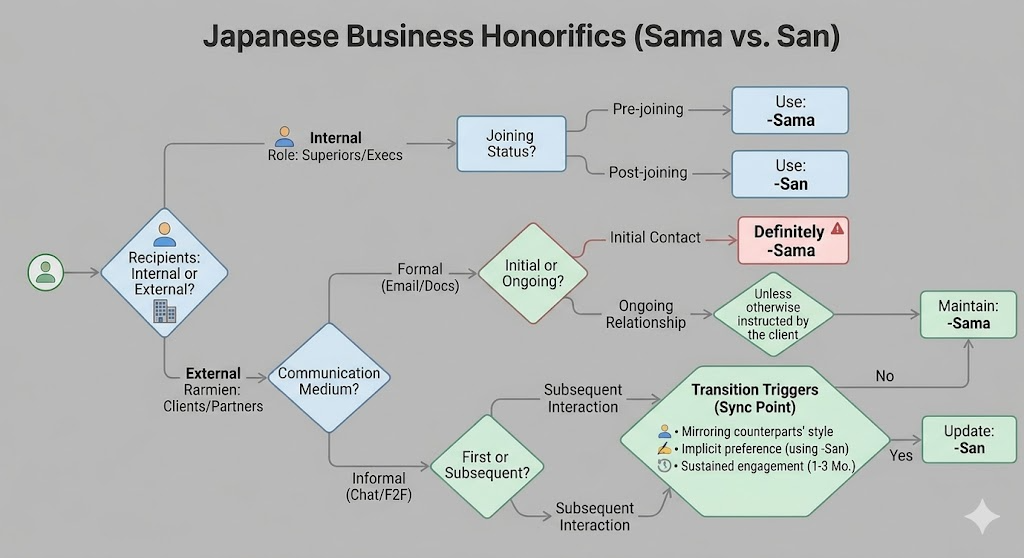
Analysis
Internal Relationships (Uchi)
Before Joining the Company
In the pre-hiring stage, you and the company are essentially strangers. The relationship is strictly defined as an interviewer and an interviewee. Because there is a formal gap between the two parties, you should always use -Sama to maintain the appropriate level of respect and formality.
After Joining the Company
The moment you are hired, you are no longer a stranger; you become part of a team working toward a common goal. In this “Uchi” environment, using -San even for superiors is the professional standard. However, some companies prefer using job titles like “President” or “Manager” instead of suffixes. Since every corporate culture is different, a good strategy is to observe how your colleagues address their bosses. You can also ask your superior directly how they prefer to be called. Taking the initiative to clarify honorifics for the sake of smooth communication is almost always welcomed as a sign of professional maturity.
External Relationships (Soto)
Formal Settings (Emails and Documents)
In written communication such as emails, -Sama is the absolute rule. Because written records remain permanently, it is standard practice to prioritize risk management and use the most formal title to avoid any potential for misunderstanding or offense.
Chat and Face-to-Face Interactions
Deciding which title to use in more fluid interactions can be difficult. A key criterion is whether you and the other party have begun to share the same “distance norms.” If there is an explicit agreement, such as the client saying “-San is fine,” you should follow their lead. Another effective strategy is “mirroring”—if the other party gradually becomes more casual and starts using -San when addressing you, it is appropriate for you to do the same. If a continuous working relationship lasts for a significant period, that is also a natural time to consider switching from -Sama to -San. While these rules can be complex, remember that sincere communication and a respectful attitude are more important than the specific title itself. Most professionals will not be overly concerned with which suffix you choose as long as they feel respected and valued.
Case Study
Case 1: Emailing a Client (External)
Situation: You are sending an introductory email to a potential client, Mr. Tanaka, whom you have never met.
Japanese: 「田中様、お世話になっております。」
(English): “Dear Mr. Tanaka, thank you for your continued support.”
Explanation: In a written formal context with an external partner (Soto), -Sama is the essential “safety wall.” Since you have no prior relationship, you must use the highest level of respect to establish your professionalism and credibility.
Case 2: Speaking to Your Boss (Internal)
Situation: You are reporting a project update to your manager, Mr. Sato, in the office.
Japanese: 「佐藤さん、プロジェクトの件でご報告があります。」
(English): “Mr. Sato, I have a report regarding the project.”
Explanation: Inside the office (Uchi), -San is the standard interface for spoken communication. Even when addressing a superior, using -Sama face-to-face would create an unnatural and stiff distance that can hinder smooth teamwork.
Common Mistakes
Case 1: Icebreaking with your boss on your first day
Situation: You are meeting your new boss, Mr. Tanaka, for the first time and trying to start a friendly conversation.
Japanese: 「田中様はこの会社で何年働かれているんですか?」
(English): “Mr. Tanaka, how many years have you been working at this company?”
Reason for the mistake: Using -Sama for a teammate—even your boss—is an error in “Distance Design.” Within the same organization (Uchi), -San is the professional standard. Using -Sama creates an unnatural, stiff wall that makes you sound like a stranger or a guest rather than a member of the team.
Case 2: Sending an email to a new client
Situation: You are writing an email to a new client, Mr. Sato at Orange Co., Ltd., for the first time.
Japanese: 「Orange株式会社 佐藤さん、いつもお世話になっております。」
(English): “Dear Mr. Sato at Orange Co., Ltd., thank you for your continued support.”
Reason for the mistake: Using -San for a client is an error in “Distance Design.” For external partners (Soto), especially in a formal record like an email, -Sama is the essential standard. Even if you want to be friendly, using -San in a first email is seen as too casual and may signal a lack of professional etiquette. You must use -Sama to build a proper “wall” of respect.
Quiz: -Sama or -San?
1. Adjusting a Zoom schedule on Chat
- Scenario: You have been working with this client for about six months. You are currently coordinating a meeting via a business chat tool.
- Sentence: 「お疲れ様です。来週のズームミーティングは水曜日の午前9時を予定しているのですが、鈴木( )のご都合はいかがでしょうか。」
- (Meaning): “Hi, regarding next week’s Zoom meeting, we are looking at Wednesday at 9:00 AM. Does that work for you, [Mr./Ms.] Suzuki?”
2. Asking a question during a job interview
- Scenario: You are in a job interview. The interviewer, Mr. Otani, asks if you have any questions for him.
- Sentence: 「大谷( )がこの会社で成し遂げたいことを教えていただきたいです。」
- (Meaning): “I would like to know what you, [Mr.] Otani, want to achieve at this company.”
Summary
| Situation | Recommended Title | Core Logic | Risk of Wrong Choice |
| External (Clients / New Partners) | -Sama | The High Wall: Maintains formal distance and shows maximum respect to “Soto” (outsiders). | High: Using -San can be perceived as rude or lack of etiquette. |
| Internal (Superiors / Team) | -San (or Job Title) | The Bridge: Balances respect with teamwork efficiency within the “Uchi” (inner circle). | Medium: Using -Sama creates an awkward, excessive distance. |
| First Contact / Written Email | -Sama | Risk Management: Formal records require the highest safety standard to build initial trust. | High: Mistakes leave a permanent record of unprofessionalism. |
| Established Chat / Spoken | -San | Fluidity: Prioritizes real-time rapport and smooth communication speed. | Low: The focus shifts from formal rules to psychological closeness. |
Q1: -San While using -Sama is not technically incorrect, -San is much more natural here. Given the informal nature of chat tools and the fact that you have maintained a relationship for six months, -San helps build a professional “bridge” that feels more appropriate for ongoing collaboration.
Q2: -Sama In a job interview, it is best to play it safe. Unless the interviewer is exceptionally casual or explicitly instructs you to be less formal, using -Sama is the standard way to show maximum respect (the “High Wall”) in a high-stakes, formal environment.
コメント